
The London Property Market 2026: Prime London Trends
28 August 2026
Prime Central London (PCL) — Mayfair, Belgravia, Knightsbridge, South Kensington — entered 2026 in a quiet reset: after years of tax reform and surcharges, prices sit well below their historic peaks while transaction volumes revive. This is a market analysis; for buy-to-let math see our BTL guide, and for the growth corridors our areas guide.
The 2026 Picture: Five Indicators
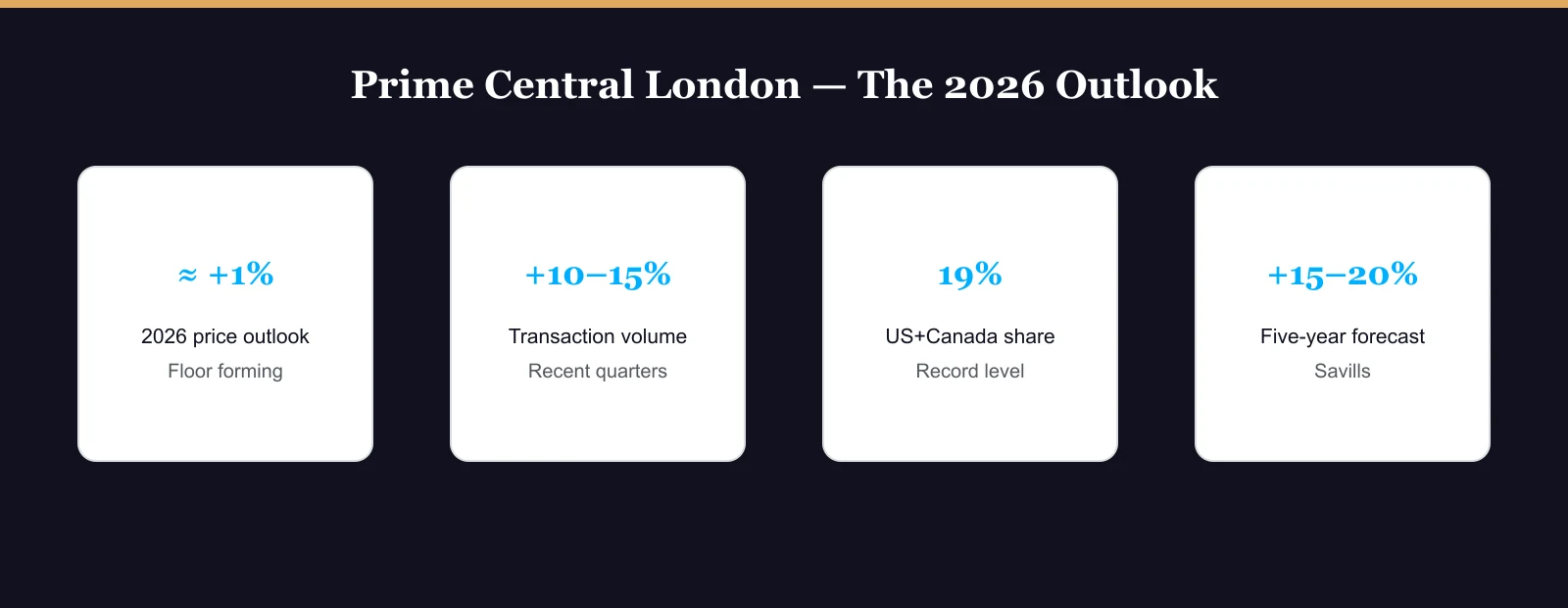
| Indicator | 2026 status | Read |
|---|---|---|
| Price outlook (full year) | ≈ +1% / flat (Savills) | End of the down-cycle; a floor forming |
| Transaction volume | +10–15% in recent quarters | Waiting buyers returned to the field |
| US+Canada buyer share | 19% of overseas applicants (record) | Dollar strength + the safe-haven thesis |
| Five-year forecast | PCL +15–20% (Savills) | The recovery-from-reset scenario |
| Prime yields | 2.5–4% gross | An asset play — not a percentage play |
What Created the Reset?
- Tax architecture: the additional-home (5%) and non-resident (2%) surcharges plus the end of the non-dom regime braked PCL's most sensitive demand layer for years.
- Sterling and the dollar: for dollar-based buyers PCL now offers a double discount versus the peak (price + currency) — the main engine of the record American share.
- Supply character: prime-street supply is inelastic; sellers can wait rather than cut, so corrections run slow but long — which is why today's floor matters.
Submarkets: There Is No Single "Prime"
- Mayfair & Belgravia: the trophy segment; few transactions, high resilience. The first stop of global wealth chasing the currency edge.
- Knightsbridge & South Kensington: classic flat stock; corporate/family rental demand is strong and refurbished product earns a premium.
- The prime fringe (Marylebone, Notting Hill, the Chelsea ridges): "value prime" — sharing the central reset while standing out on liveability.
- New-prime (Nine Elms/Battersea): tower stock priced apart from classic PCL; liquidity rides branded projects.

The Submarket Report Card
| Submarket | 2026 status | Buyer profile |
|---|---|---|
| Mayfair – Belgravia | Trophy; few transactions, price resilience | Global wealth chasing the currency edge |
| Knightsbridge – S. Kensington | Refurbished stock earns a premium | Family + corporate-tenant investors |
| The prime fringe (Marylebone, Notting Hill) | "Value prime" — sharing the reset | Buyers balancing lifestyle and asset |
| New-prime (Nine Elms) | Tower stock; brand-driven liquidity | International buyers wanting modern product |
Worked Perspective: The Dollar Buyer's Math
A Knightsbridge flat that peaked at £2M can change hands around £1.7–1.8M today; converted to dollars the effective discount can reach 25–30% with the currency effect. If the five-year +15–20% scenario lands, a dollar buyer entering at the cycle floor books double-digit total returns even assuming a flat currency. The risk side: the tax architecture is permanent — this is a 5–10 year asset-thesis market, not a flip market.
The Rental Side: The Quiet Strength
While sale prices hunted for a floor, PCL rents held firm: corporate relocation, embassy-finance demand and the scarcity of refurbished stock carry prime rents independently of the sales cycle. The result: a price reset plus resilient rents pulled prime yield percentages to their most reasonable point in years — "relatively good yield in an asset market" is a rare combination, and usually a cycle-floor marker.
Three Signals to Watch in 2026–27
- Volume persistence: the +10–15% revival extending across consecutive quarters would confirm the floor.
- The rate path: every easing in mortgage costs revives non-prime London and chains demand up into PCL.
- Policy stability: a fresh wealth/property tax round is the one real downside risk; the market has already priced the current architecture.
What the Analysis Tells Investors
- For wealth-preservation buyers: the reset plus currency offers the most reasonable PCL entry window of the decade; the only urgency is volume turning into price.
- For yield-focused investors: PCL is still not a percentage market — cash-flow portfolios belong in the growth corridors of our areas guide.
- The blended strategy: a core PCL asset plus an outer-corridor yield flat is 2026's most balanced London basket.
Our prime portfolio runs from $575k to $33M; talk to our advisors to weigh the PCL entry window together.
Frequently Asked Questions
What are PCL prices doing in 2026?
Savills projects roughly +1%/flat for the year — a floor-forming phase after the long down-cycle. Transactions meanwhile revived 10–15% in recent quarters.
Why is PCL below its peak?
The additional-home (5%) and non-resident (2%) surcharges plus the end of the non-dom regime braked the most sensitive demand layer; prices repriced to that architecture.
Is the American buyer share really a record?
Yes — US+Canada reached 19% of overseas buyer applicants; dollar strength and the safe-haven search drive it.
What is the five-year outlook?
Savills forecasts +15–20% for PCL over five years — the recovery-from-reset scenario.
Is now the right time to buy?
For wealth preservation on a 5–10 year horizon the window is attractive (price + currency double discount); for short-term flipping it is not — the tax architecture is permanent.
What are prime rental yields?
The 2.5–4% gross band — PCL is an asset market, not a percentage market. For yield portfolios see our growth-corridors guide.
Which submarket stands out?
Refurbished classic stock in Knightsbridge/South Kensington; the Marylebone–Notting Hill line in 'value prime'; Mayfair–Belgravia resilience in the trophy segment.
What is the biggest downside risk?
A fresh wealth/property tax round. The market has priced the current structure; a surprise policy shift would test the floor.