

Miami Real Estate Investment & Rental Yields (2026)
17 July 2026
Miami remains the number-one US address for foreign investors in 2026: international buyers purchased $4.4 billion of South Florida homes last year (up from $3.1 billion), and 51% of those deals were all-cash. The US places no restrictions on foreign nationals buying residential property — title, financing and rental rights are the same as for citizens.
This guide summarises how rental yield versus appreciation varies by neighborhood, which area suits which investor profile, and the costs you must budget for.
The Big Picture
Typical gross rental yields in Miami sit in the 5–6% band — below Dubai's percentages, but in a stable, dollar-denominated market with strong capital growth. Occupancy in major residential towers runs a very healthy 93–97%. Returns come on two legs — rent plus appreciation — and neighborhood choice sets the balance between them.
Neighborhood by Neighborhood: Yield or Appreciation?
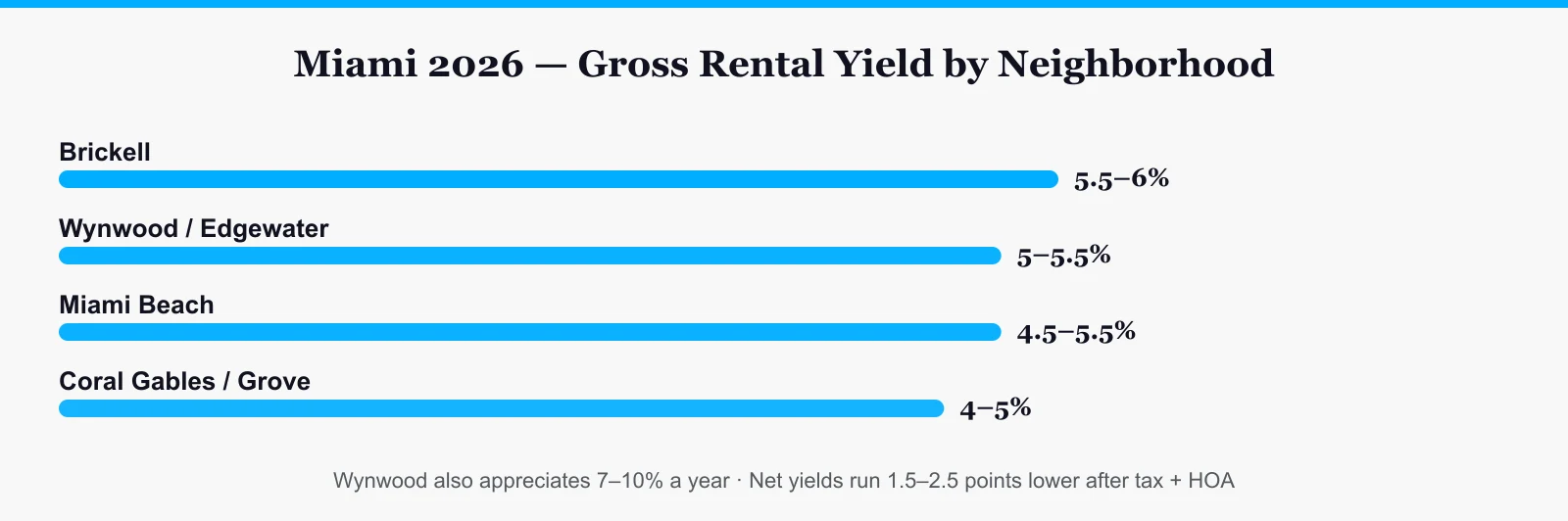
| Neighborhood | Gross Yield | Annual Appreciation | Profile |
|---|---|---|---|
| Brickell | 5.5–6% | Mid-strong | Financial district; corporate tenants, high occupancy |
| Wynwood / Edgewater | 5–5.5% | 7–10% | Transformation zone; modest cash flow, appreciation champion |
| Miami Beach | 4.5–5.5% | Mid | Holiday-rental potential; watch building & city rules |
| Coral Gables / Coconut Grove | 4–5% | Steady | Family/luxury segment; long-term wealth preservation |
Price reference: mid-tier new construction in Brickell trades at $700–1,000 per sqft; one-bed rents run $2,800–3,800 and two-beds $4,200–6,500 a month.
Worked Example: The Honest Math of a Brickell One-Bed
Purchase $600,000 (with ~1.5% closing, true entry ≈ $609,000). Rent $3,200 a month → $38,400 a year (6.4% gross). Costs: property tax (~1.8%) 10,800 + HOA (~$700/mo) 8,400 + insurance 2,500 + management (8%) 3,100 + vacancy 1,900 ≈ $26,700. Net income $11,700 → net yield ≈ 1.9% + appreciation. That is the essence of Miami math: cash flow is modest; the main return engines are dollar-based appreciation and the tax-deductibility of expenses. (Add 5–7% appreciation and total returns approach double digits.)
Ready Condo or Pre-Construction?
- Ready (resale/new delivery): immediate rental income, known HOA/tax; wider negotiating room in existing stock.
- Pre-construction: staged 20–40% deposit plans and delivery-date upside; in exchange, 2–4 income-free years and developer risk. It is the model foreign buyers use most — deposits sit in escrow.
How Easy Is It for a Foreign Investor?
- No restrictions: foreigners buy, rent out and sell US homes on the same terms as citizens.
- Remote purchase is routine: power of attorney and online closings are common.
- Financing: foreign-national mortgage products exist at 25–30% down; cash buyers gain real negotiating power.
- ID/tax: an ITIN is needed to declare rental income; buying through an LLC is a common structure.
The Costs You Must Budget For
Three items drive the gross-to-net gap in Miami: annual property tax (effective ~2% in Miami-Dade), HOA fees (a serious monthly item in condo towers) and insurance (rising policies in a hurricane zone). Net yield typically lands 1.5–2.5 points below gross. We will publish the full tax and closing-cost breakdown in a separate guide.
Real Numbers From Our Portfolio
Across our 58 live Miami listings the median is $1,185,000, ranging from $395,000 (entry-level condos) to $5.8 million (waterfront luxury). Both first-investor budgets and wealth-preservation buyers have real options — filtering by the neighborhood profiles above is quick.
The Purchase Process: From Offer to Closing
| Step | Action | Time |
|---|---|---|
| 1. Offer + contract | Written offer, negotiation, purchase agreement; deposit goes into escrow | 1–7 days |
| 2. Inspection | Structural/mechanical review; right to walk away or renegotiate on critical defects | 7–15 days |
| 3. Title search + insurance | The title company clears the history and issues title insurance | 2–3 weeks |
| 4. Closing | Signatures + funds; cash closings can be done remotely by POA | Cash 2–4, financed 4–6 weeks |
Condo purchases add one step: buyer approval by the building association — an application fee and a 1–4 week review are common; put both in your budget and timeline.
Short-Term Rentals: Check the Rules
Holiday rentals in Miami Beach and other districts are tightly governed by building and municipal rules; many condos allow annual leases but ban stays under 30 days. If short-term income is your goal, verify the building's rental policy before you buy — a limited set of projects marketed as "Airbnb-friendly" are designed for that model.
Which Neighborhood for Which Investor?
- Rental income + occupancy: Brickell — the financial district's tenant pool runs deep.
- Appreciation focused: Wynwood, Edgewater — mid-transformation, strong on an 8–10 year horizon.
- Holiday home + seasonal income: Miami Beach — subject to verifying the rules.
- Wealth preservation / family: Coral Gables, Coconut Grove — stability and prestige.
Browse our Miami listings, or contact us to match the right project to your budget.
Frequently Asked Questions
Can foreigners buy property in Miami?
Yes. The US places no restrictions on foreign buyers; title, rental and resale rights are identical to citizens'. Remote purchases via power of attorney are routine.
What is the average rental yield in Miami?
Typical gross yields in 2026 run 5–6%: Brickell 5.5–6%, Wynwood 5–5.5%, Coral Gables 4–5%. Net yields land 1.5–2.5 points lower after property tax, HOA and insurance.
Should I prioritise rent or appreciation?
It depends on budget and horizon: high-occupancy districts like Brickell for steady income, transformation zones like Wynwood/Edgewater for capital growth.
Can I get a mortgage as a foreigner?
Yes. Foreign-national mortgage products typically require 25–30% down; rates run somewhat above local-buyer products.
Are Airbnb / short-term rentals allowed?
It varies by district and building. Many condos ban stays under 30 days, and Miami Beach enforces strict municipal rules. Verify the building's policy before buying.
Which costs should I budget for?
Annual property tax (effective ~2%), HOA fees, insurance, management and a vacancy allowance. Together they cut gross yield by 1.5–2.5 points.
What is an ITIN and why do I need one?
An ITIN is the US individual taxpayer number for non-residents; you need it to declare rental income and claim refunds.
Is buying through an LLC worth it?
It is a common structure for liability protection and estate planning; costs and tax effects vary by person — review with a US tax advisor.