
Dubai Rental Yields & ROI: Which Area Earns What? (2026)
14 July 2026
Rental yield is a property's annual rental income divided by its purchase price: gross yield = annual rent ÷ purchase price × 100. In 2026 Dubai offers 5–9% gross yields depending on the area — one of the highest of any global market, where the metropolitan average sits around 3–4%. On top of that, rental income is not subject to income tax and there is no annual property tax.
Still, deciding on gross numbers alone is the most common investor mistake. This guide covers 2026 yields area by area, the service charges that separate gross from net, the short-term rental option and how to calculate real ROI.
Rental Yields by Area in 2026
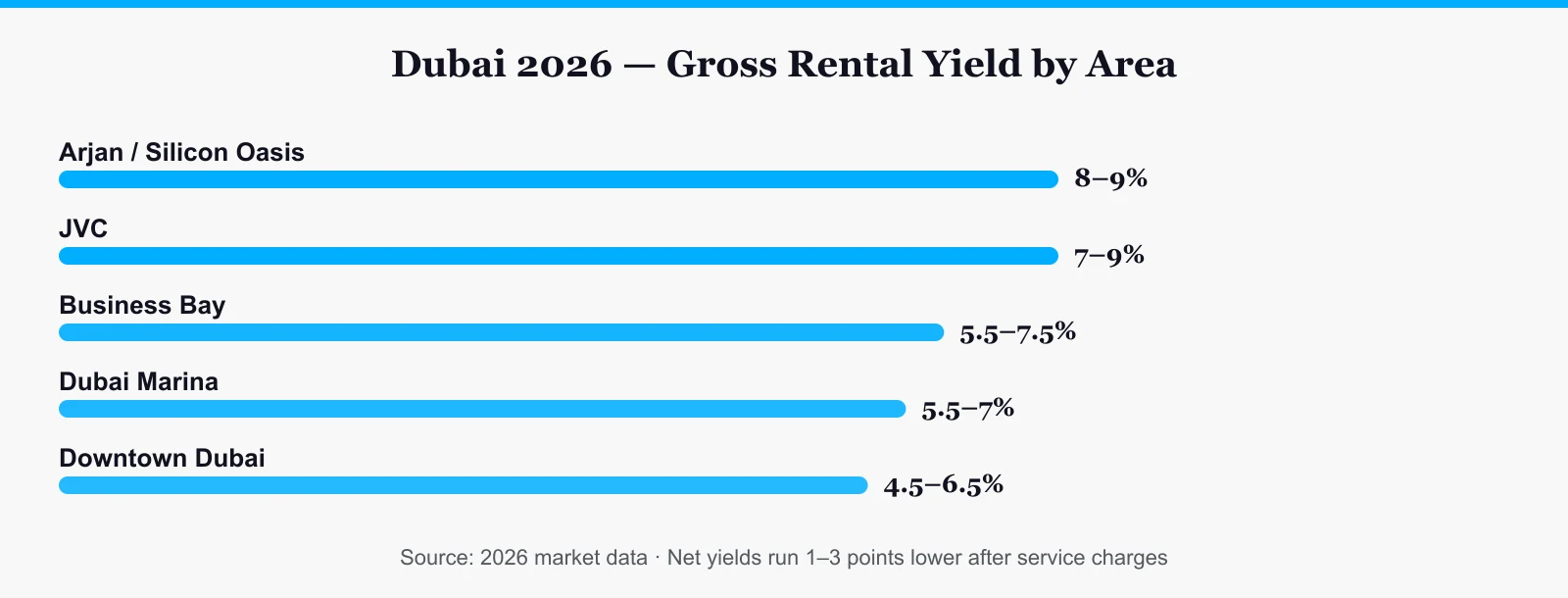
The general rule: the lower the entry price, the higher the percentage yield. Mid-market communities win on percentage, while central districts win on appreciation and liquidity.
| Area | Gross Yield (2026) | Profile |
|---|---|---|
| JVC (Jumeirah Village Circle) | 7–9% | Affordable entry, ideal first investment |
| Arjan / Dubai Silicon Oasis | 8–9% | Rising mid-market, strong demand |
| Business Bay | 5.5–7.5% | Central, corporate tenant base |
| Dubai Marina | 5.5–7% | Tourist appeal, short-term potential |
| Downtown Dubai | 4.5–6.5% | Prestige + appreciation; lower percentage |
As of April 2026 the citywide average gross yield is 6.7% (apartments: 7.2%). Percentage hunters should also watch the budget-friendly satellite districts: International City (~8.2%), Dubai Sports City (~7.5%), Dubai South (~7.2%) and Discovery Gardens (~7.0%) produce the city's highest gross yields — in exchange, brand value and long-term appreciation trail the central districts.
How to Calculate Yield (Formula + a Real Example)
Use both formulas together for a sound decision:
- Gross yield = annual rent ÷ purchase price × 100
- Net yield = (annual rent − service charges − management − maintenance − vacancy) ÷ (purchase price + acquisition costs) × 100
Worked example — a JVC one-bed: Purchase AED 1,000,000 + acquisition costs (~7%) → true entry 1,070,000. Annual rent 80,000 (8% gross). Costs: service charges 15,000 + management (6%) 4,800 + maintenance reserve 5,000 + vacancy (6%) 4,800 = 29,600. Net income 50,400 → net yield 4.7%. That is the honest version of the "8% gross" listing — still clearly above London's after-tax net.
| District type | Typical payback period |
|---|---|
| Budget-friendly (JVC, International City) | 12–15 years |
| City average | 14–20 years |
| Premium (Marina, Downtown) | 18–25 years |
Gross Misleads: Calculate the Net Yield
The gap between gross and net is driven largely by service charges. In Dubai they range from AED 12–35 per sqft per year: AED 12–18 in areas like JVC, AED 25–35 in premium districts like Downtown/DIFC. On a 1,000 sqft apartment that is AED 12,000–35,000 a year, cutting net yield by 1–3 percentage points.
- A 9% gross yield in a mid-market community typically settles at 5.5–6.5% net.
- A 6% gross yield in Downtown nets closer to 4.8–5.5%.
- For a true net figure, also deduct professional management (5–8% of annual rent), a maintenance reserve (1–2% of property value) and a vacancy allowance (5–8%).
Annual Lease or Short-Term Rental?
In tourist districts like Marina, Downtown and JBR, short-term (holiday) rentals can outperform annual leases on gross yield — at the cost of extra fees and operations.
| Criteria | Annual Lease (Ejari) | Short-Term (Holiday) |
|---|---|---|
| Gross yield | 5–7% | 8–12% |
| Occupancy | 95%+ | 70–80% |
| Management fee | Low / none | 15–25% |
| Licence | Ejari registration | DTCM licence required |
| Net edge | Stability | +1–3 points (if well managed) |
The Tax Advantage: The Invisible Multiplier
The UAE levies no income tax on rental income and no annual property tax. In London or Miami you pay income tax and yearly property tax out of your gross yield; in Dubai the net stays in your pocket. The one significant transaction cost is the one-off 4% DLD (land department) transfer fee — we break down every purchase cost line by line in a separate guide publishing at the end of the month.
Real Numbers From Our Portfolio
The bands above are market averages; for a concrete reference: across our 100 live Dubai listings the median price is $775,000, with a range running from studio/off-plan entries ($58,000) to the ultra-luxury segment ($95 million). Both the budget-friendly entries chasing the 8–9% band and Downtown/Marina-class prestige assets sit in one portfolio — filtering by your yield target takes minutes.
Which Area for Which Investor?
- Cash-flow focused: JVC, Arjan — high percentage, affordable entry, wide tenant pool.
- Balanced: Business Bay — central location + 6–7% band, corporate tenants.
- Short-term income: Marina, JBR — tourist demand, 8–12% gross with a DTCM licence.
- Appreciation + prestige: Downtown — lower percentage but high resale liquidity and brand value.
5 Practical Rules to Boost Your ROI
- Compare net, not gross yields; ask for the service charge before you sign.
- Ready, tenant-proven buildings minimise vacancy periods.
- Studios and one-beds deliver the highest percentage yields; larger units trail on percentage.
- If short-term occupancy drops below 70%, be ready to switch to an annual lease.
- Track the RERA rental index; renewal increases are capped by it.
Browse yield-friendly apartments in our Dubai listings, or talk to our advisors about area and project selection.
Frequently Asked Questions
Which Dubai area has the highest rental yield?
In 2026 the highest gross percentages come from mid-market communities like JVC, Arjan and Dubai Silicon Oasis (7–9%). Downtown and Marina score lower on percentage but stronger on appreciation and liquidity.
What is the difference between gross and net rental yield?
Gross yield is annual rent over purchase price. Net yield deducts service charges, insurance, vacancy allowance and management fees — in Dubai typically 1–3 points below gross.
Is rental income taxed in Dubai?
No. The UAE levies no income tax on rental income and no annual property tax. Your tax position in your home country should be assessed separately.
What is Ejari?
Ejari is the mandatory official registration of annual tenancy contracts in Dubai's RERA system, protecting both landlord and tenant rights.
Do I need a licence for short-term (Airbnb-style) rentals?
Yes. Holiday-home rentals in Dubai require a DTCM licence; professional management fees typically run 15–25%.
Who pays the service charges?
Service charges are the owner's responsibility and range from AED 12–35 per sqft per year depending on the community. They are the single biggest item in a net yield calculation.
How long does a Dubai apartment take to pay for itself?
At a net 5–6.5% yield the typical payback period is 15–20 years; well-managed short-term rentals can shorten it. Capital appreciation comes on top.
Can foreigners rent out property in Dubai?
Yes. Foreigners who own in freehold areas can rent out freely on annual leases or, with a DTCM licence, short term.