
London Population 2026: 9.1 Million and Falling
15 October 2026
London's population is 9,122,909. This is the latest official figure, published by the Office for National Statistics (ONS) in July 2026 for mid-2025. The city shrank by 26,737 people (0.3%) in a year, making London the only region in England whose population fell.
Leaving aside the pandemic years, this is the first fall in London's population since the late 1980s. Below we explain how many people live in London, why you see different figures, the population of each borough and how many Turkish-born residents live in the city, using official data.
Why Are There Different Figures for London?
You may see 8.5, 9.1, 9.8, 10.4 or even 15 million quoted for London. The difference comes down to which area is meant by "London". Figures such as 8.5 million come from censuses held years ago.
| Definition | Population |
|---|---|
| City of London (historic financial district) | 15,631 |
| Greater London (32 boroughs + the City, official) | 9,122,909 |
| Built-up urban area (UN estimate) | About 10.4 million |
| Metropolitan area (including commuter belt) | About 14 – 15 million |
The figure used in official statistics, the news and council services is the population of Greater London. The right answer to "how many people live in London?" is about 9.1 million.
London Population by Year
| Year (mid-year) | Population |
|---|---|
| 2010 | 8,061,495 |
| 2015 | 8,659,545 |
| 2019 | 8,889,743 |
| 2020 | 8,867,008 |
| 2021 | 8,804,769 |
| 2022 | 8,917,360 |
| 2023 | 9,066,906 |
| 2024 | 9,149,646 |
| 2025 | 9,122,909 |
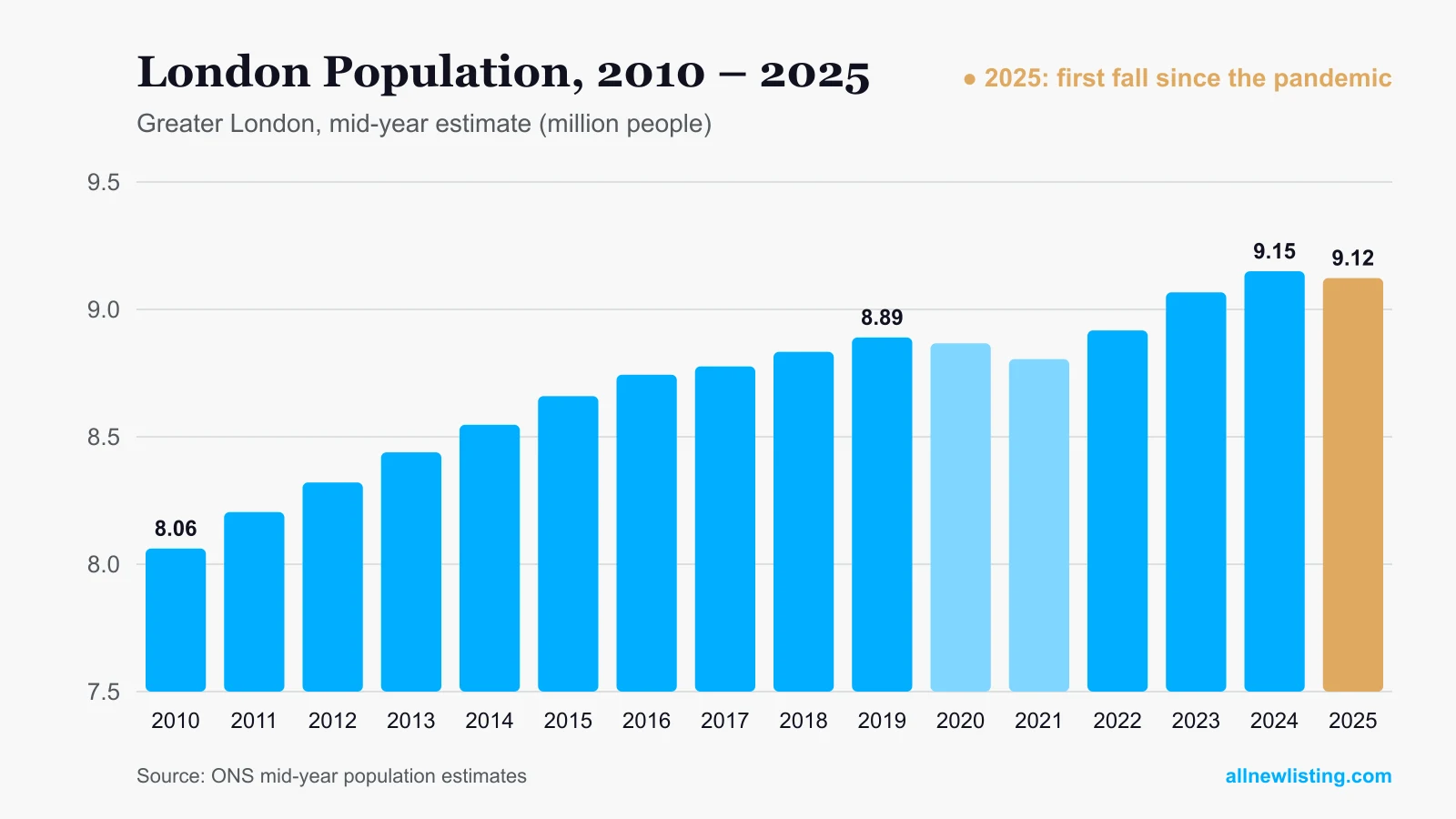
London grew by about 1.06 million people between 2010 and 2025. It fell for two consecutive years during the pandemic, then recovered quickly to a record high between 2022 and 2024, before falling again in 2025. The official figure for 2026 will be published in summer 2027. Until then, the most accurate answer is 9.1 million.
Why Is London Shrinking?
Births in London still outnumber deaths, and more people arrive from abroad than leave. In other words, the city is still growing through natural change and international migration. The fall comes from moves within the UK.
According to ONS data, about 420,000 people moved from London to other parts of the country in a year, roughly 131,000 more than moved in from other regions. High housing costs and the search for larger homes are among the most commonly cited reasons for this move.
A national fall in immigration also played a part. Net international migration to England and Wales fell from 612,000 to 212,000 in a year, which was not enough to offset what London lost through internal migration.
London Population by Borough
London is made up of 32 boroughs and the City of London. In 2025, 23 of these 33 areas saw their population fall. Croydon is the most populous borough, while Camden shrank the fastest. Central boroughs such as Westminster, Southwark and Lambeth were among the biggest losers, while outer boroughs such as Barking and Dagenham and Havering kept growing.
| Rank | Borough | Population (2025) | Annual change |
|---|---|---|---|
| 1 | Croydon | 410,085 | +0.4% |
| 2 | Barnet | 408,087 | +0.5% |
| 3 | Ealing | 387,072 | -0.2% |
| 4 | Newham | 376,542 | -0.8% |
| 5 | Brent | 352,201 | -0.9% |
| 6 | Wandsworth | 339,859 | +0.0% |
| 7 | Bromley | 336,048 | +0.4% |
| 8 | Tower Hamlets | 334,240 | -0.6% |
| 9 | Enfield | 329,400 | -0.6% |
| 10 | Hillingdon | 326,671 | -0.4% |
| 11 | Redbridge | 321,829 | -0.4% |
| 12 | Lambeth | 314,298 | -1.4% |
| 13 | Southwark | 312,366 | -1.5% |
| 14 | Greenwich | 301,225 | -0.0% |
| 15 | Lewisham | 301,037 | -0.5% |
| 16 | Hounslow | 299,486 | -0.2% |
| 17 | Waltham Forest | 283,713 | -0.0% |
| 18 | Havering | 280,787 | +1.4% |
| 19 | Harrow | 272,612 | +0.6% |
| 20 | Hackney | 266,241 | -0.9% |
| 21 | Haringey | 266,218 | -0.9% |
| 22 | Bexley | 257,103 | +0.3% |
| 23 | Barking and Dagenham | 238,295 | +1.5% |
| 24 | Islington | 224,551 | -0.7% |
| 25 | Merton | 218,891 | -0.5% |
| 26 | Camden | 216,658 | -1.8% |
| 27 | Sutton | 213,972 | +0.1% |
| 28 | Westminster | 212,367 | -1.5% |
| 29 | Richmond upon Thames | 196,713 | -0.1% |
| 30 | Hammersmith and Fulham | 190,216 | -0.3% |
| 31 | Kingston upon Thames | 172,761 | -0.1% |
| 32 | Kensington and Chelsea | 145,734 | -1.0% |
| 33 | City of London | 15,631 | +0.9% |
How Many Turkish People Live in London?
According to the 2021 Census, 72,867 people born in Turkey live in London, and 69,641 people speak Turkish as their main language. Turkish is among the most widely spoken foreign languages in the city.
Figures of 400,000 – 600,000 often quoted for the Turkish community measure something different. These estimates include Turkish Cypriots, second and third generations born in the UK, and Kurdish and Alevi communities from Turkey. The census counts only country of birth and declared language, so its figure is lower.
| Borough | Born in Turkey | Share of borough population |
|---|---|---|
| Enfield | 17,053 | 5.2% |
| Haringey | 9,465 | 3.6% |
| Hackney | 8,674 | 3.3% |
| Islington | 4,220 | 1.9% |
| Waltham Forest | 3,516 | 1.3% |
Enfield, Haringey and Hackney in North London have the highest concentration of Turkish shops, restaurants and community centres, and Green Lanes has become a symbol of the community.
London's Multicultural Make-up
40.6% of Londoners were born outside the United Kingdom. According to the 2021 Census, 53.8% of the population is White, 20.7% Asian, 13.5% Black, 5.7% Mixed and 6.3% from other ethnic groups.
More than 300 languages are spoken in the city. After English, the most common main languages are Romanian (159,000), Spanish (117,000), Polish (112,000), Bengali (102,000) and Portuguese (94,000). London covers 1,572 km², with about 5,800 people per square kilometre, more than ten times the average for England.
How Is the Population Fall Affecting House Prices and Rents?
The fall in population has produced two different pictures in the housing market. According to ONS data from September 2026, London house prices have fallen year on year for 11 consecutive months. The average price fell 3.3% in a year to £569,000, with the sharpest falls in inner London boroughs, where population is also falling fastest. You can see current listing averages area by area on our London house prices page.
Rents, on the other hand, are still rising. Average monthly rent in London rose 3.5% in a year to £2,332, the highest in the country, and reaches £3,690 in Kensington and Chelsea. We have compiled rents by area in our London rent prices guide.
In short, London house prices are on their weakest trend since January 2024, while costs keep rising for tenants.
Frequently Asked Questions
What is the population of London?
According to the latest official ONS estimate, Greater London had 9,122,909 residents in mid-2025. For 2026 the figure is taken as about 9.1 million.
How many million people live in London?
About 9.1 million people live in London. Including the surrounding commuter belt, the metropolitan area reaches 14 – 15 million.
How many Turkish people live in London?
According to the 2021 Census, 72,867 people born in Turkey live in London. Including Turkish Cypriots and UK-born generations, the wider Turkish community is estimated at over 400,000.
Where do most Turkish people live in London?
Enfield, Haringey and Hackney in North London have the largest Turkish populations. Enfield alone is home to more than 17,000 people born in Turkey.
What is the population of the UK?
The population of the United Kingdom was about 69.5 million in mid-2025. England alone had 58.8 million residents.
How big is London?
Greater London covers 1,572 km², with about 5,800 people per square kilometre.