
Istanbul Real Estate Investment: Yields & Standout Areas (2026)
14 August 2026
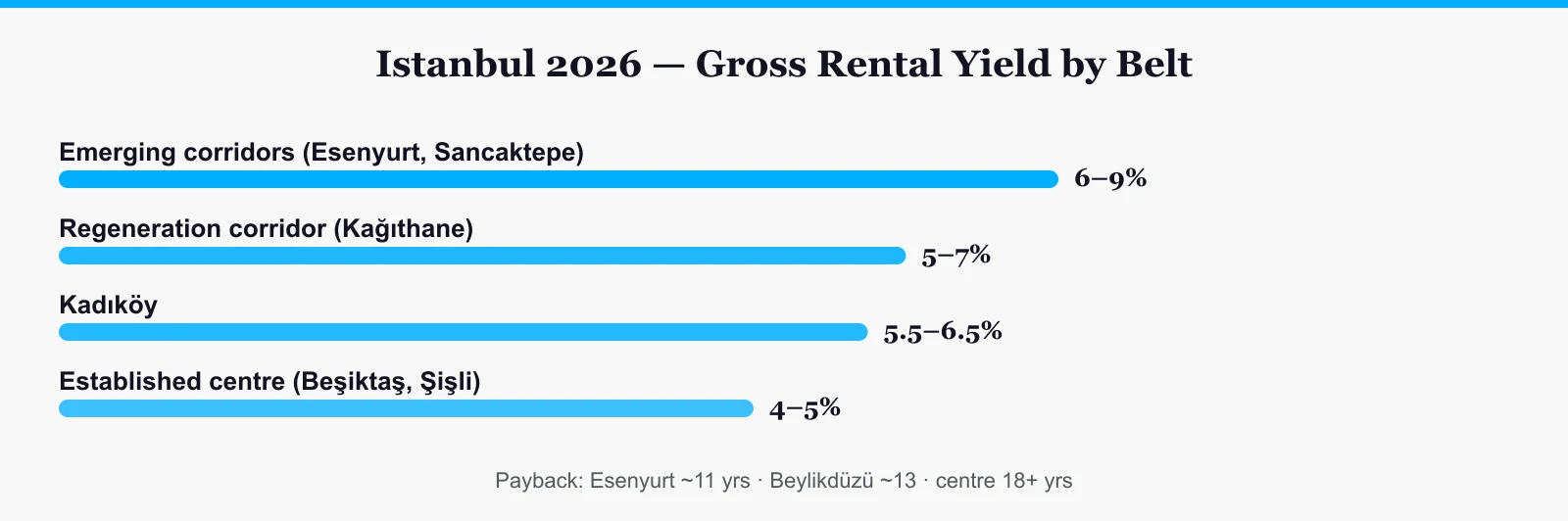
In 2026 Istanbul offers investors two distinct games: high percentage on the emerging corridors (6–9% gross) or wealth preservation in the established centres. Citywide residential yields run 4–8%; the top of the band is reached when the right district meets the right tenant profile. This article is strategy-focused — for the buying process, documents and costs see our step-by-step guide.
The 2026 Yield Map by District
| Belt | Gross yield | Payback | Character |
|---|---|---|---|
| Emerging corridors (Esenyurt, Sancaktepe, Beylikdüzü) | 6–9% | ~11–13 years | The city's fastest payback; heavy supply, selectivity essential |
| Transformation corridor (Kağıthane, Eyüpsultan) | 5–7% | ~13–15 years | Metro + renewal; a medium-term appreciation thesis |
| Kadıköy | 5.5–6.5% | ~15–17 years | Rent champion (TRY 651/m², first in Istanbul); minimal vacancy risk |
| Established centre (Beşiktaş, Şişli) | 4–5% | 18+ years | Wealth preservation; corporate/professional tenants |
Reference: Kadıköy sells at $3,800–5,300/m² yet tops the city's rent per m² — the textbook "expensive but always occupied" balance.
Tenant Profile: The Invisible Driver of Yield
- Young professionals/students (Kadıköy, Şişli, Kağıthane): small units let fast; one-beds out-yield two-beds.
- Family tenants (Beylikdüzü, Başakşehir): longer contracts, lower turnover cost; growth rides the metro line.
- Corporate/expat (Beşiktaş, Levent fringe): FX-indexed rent is negotiable; asset quality is critical.
- Airport/logistics workers (Sancaktepe, the Pendik line): a newer but steady demand layer.
Worked Example: One Budget, Three Outcomes
With roughly $250,000 (2026):
| Option | Gross yield | Thesis |
|---|---|---|
| New two-bed in Beylikdüzü | ~7% | Cash flow + ~13-year payback; heavy supply makes project selection decisive |
| One-bed in a Kağıthane regeneration project | ~6% | Metro + centre proximity; medium-term appreciation share |
| Resale one-bed in Kadıköy | ~6% | The city's deepest tenant pool; vacancy ≈ zero |
All three are defensible — the difference is your priority: maximum percentage, appreciation, or ease of operation?
Micro-Location: The Station Earns, Not the District
In Istanbul the yield gap between two neighbourhoods of one district can exceed the gap between two districts. Three micro-rules:
- Real walk to the metro <8 min: it is the first filter on listing portals; every minute beyond eight erodes the rent.
- The campus/hospital/plaza triangle: a single anchor (university, city hospital, office tower) can carry a neighbourhood's demand alone.
- New-line announcements: metro route news prices in years before opening — the area wins before a shovel hits the ground.
A Note for Dollar-Based Thinkers
TL rent growth looks strong (new-tenant index +36.7% a year), but make the decision on dollar-based net yield: FX pass-through, rent-increase caps and eviction process costs must be in the math. FX-indexed corporate tenants in established districts partially hedge this risk.
Contract Practices: Three Clauses That Protect Your Yield
- The currency restriction: residential leases between Turkish residents must be in TL; exceptions exist with non-resident tenants — if you target expats, structure the contract correctly from the start.
- Deposit + notarised vacate undertaking: 2–3 months' deposit and a notarised eviction undertaking are standard in corporate lets; they cut your turnover cost sharply.
- Fee transparency: stating the service charge's share within the rent in the listing is the cheapest way to find the right tenant fast.
Real Numbers From Our Portfolio
Our curated Istanbul listings run $720k–$3.57M (median $1.1M), weighted to the prestige/centre belt — the assets of the "wealth preservation + corporate tenant" strategy. For current district-level price levels see our Istanbul home prices page.
Area Match by Investor Type
- Cash-flow maximisation: the Esenyurt–Beylikdüzü axis (selectively), Sancaktepe — short payback.
- Balanced growth: Kağıthane, Eyüpsultan — the regeneration + metro pair.
- Low-risk rent machine: Kadıköy — peak rents, near-zero vacancy.
- Wealth preservation: Beşiktaş, the Bosphorus fringe — an asset play, not a percentage play.
Reach our advisors to pin down your area-strategy match and scan the portfolio together.
Frequently Asked Questions
What is Istanbul's average rental yield?
In 2026, 4–8% citywide; 6–9% in emerging districts and 4–5% in the established centre.
Which districts have the shortest payback?
Esenyurt (~11 years), Sancaktepe (~12) and Beylikdüzü (~13) — the city's fastest; heavy supply makes project selection critical in return.
Why is Kadıköy the 'rent champion'?
At TRY 651/m² it has Istanbul's highest unit rent and deepest tenant pool; vacancy is practically near zero.
What makes Kağıthane stand out?
The metro + urban renewal + centre proximity trio; the right project carries a medium-term appreciation share.
One-bed or two-bed for better yield?
One-beds lead on percentage in young-professional/student districts; two-beds bring longer contracts and lower turnover in family districts.
Do rent-increase caps affect returns?
Increases for sitting tenants are regulated; new lets price at market (new-tenant index +36.7%). Add eviction/turnover costs to long-term math.
Should I think in dollars?
Yes — adjust TL yields for FX pass-through; FX-indexed corporate tenants (Beşiktaş/Levent line) partially hedge the risk.
Why isn't the buying process covered here?
Deliberately: the process, documents, the 8–10% extra costs and residence/VAT rules are detailed in our step-by-step guide.