

Miami Rental Prices 2026: Rent by Neighborhood
25 June 2025
As of September 2026, the average asking rent for a newly listed home in Miami is $2,761 a month, far above the US norm. But rent in Miami can almost double depending on the neighborhood: the average asking rent is $3,778 in Brickell and $1,637 in Little Haiti.
In this guide we cover Miami rental prices by number of bedrooms and by neighborhood, along with how much rents have risen in recent years. Official figures come from the US Census Bureau and the Bureau of Labor Statistics (BLS).
How Much Is Average Rent in Miami?
You will see two different rent figures for Miami, and both are correct:
| Measure | Miami | US overall |
|---|---|---|
| Average asking rent (September 2026) | $2,761 | – |
| Median gross rent, City of Miami (Census 2024) | $1,975 | $1,487 |
| Median gross rent, Miami-Dade County | $2,050 | – |
| Median gross rent, Miami Beach | $2,148 | – |
The Census figure covers everyone currently renting, including tenants who have lived in the same home for years and still pay a lower rent under an older lease. Gross rent also includes utilities such as electricity and water. Asking rent is the price of homes coming onto the market today. Anyone moving to Miami now should budget based on asking rents.
Miami is a city of renters: 67.3% of its households rent, compared with 34.7% nationally.
Miami Rental Prices by Number of Bedrooms
| Unit type | Average asking rent (September 2026) | Median rent, Census 2024 |
|---|---|---|
| Studio | $2,256 | $1,486 |
| 1 bedroom | $2,444 | $1,743 |
| 2 bedrooms | $2,977 | $2,206 |
| 3 bedrooms | $3,721 | $2,179 |
The average listed studio is about 466 square feet (43 m²), and the average one-bedroom about 731 square feet (68 m²).
Miami Rental Prices by Neighborhood
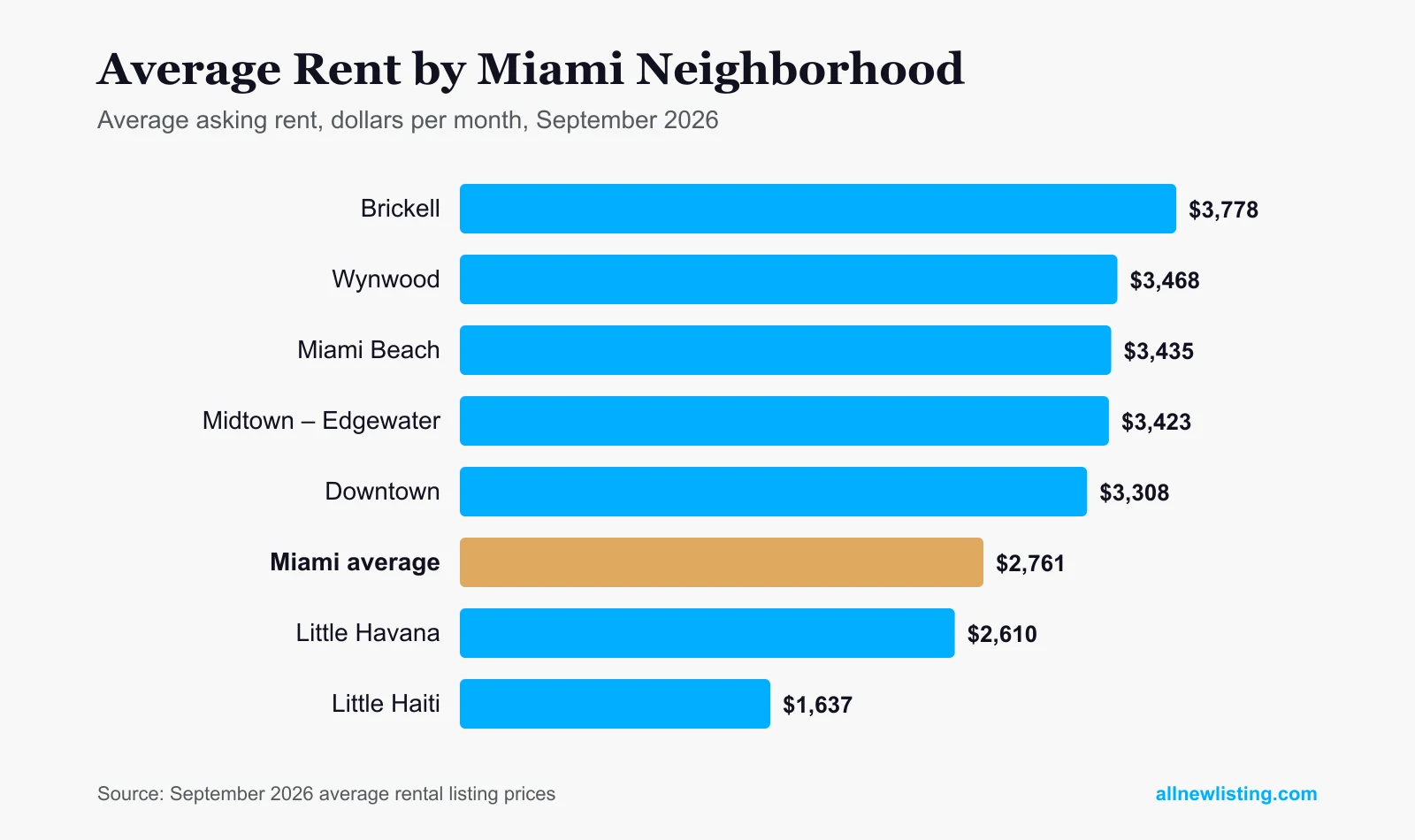
| Neighborhood | Average asking rent |
|---|---|
| Brickell | $3,778 |
| Wynwood | $3,468 |
| Miami Beach | $3,435 |
| Midtown – Edgewater | $3,423 |
| Downtown | $3,308 |
| Little Havana | $2,610 |
| Little Haiti | $1,637 |
Brickell is Miami's financial district. With a dense cluster of new residential towers, it has the city's highest rents. Downtown and Edgewater are also made up of new high-rises, and bay-view units rent for more. Wynwood, with its art galleries and restaurants, is popular with younger renters, while Miami Beach stands out for its proximity to the beach.
For lower rents, neighborhoods close to the center but with older building stock, such as Little Havana and Little Haiti, stand out. Buildings there are usually lower and older, so rents stay below the city average.
How Much Have Miami Rents Risen?
According to the rent component of the BLS consumer price index, rents in the Miami area have risen 52.1% since September 2019, compared with 34.9% nationally. Year by year:
| Year | Miami area rent growth |
|---|---|
| 2022 | +14.7% |
| 2023 | +14.4% |
| 2024 | +4.9% |
| 2025 | +3.7% |
| Last 12 months (September 2026) | +1.8% |
After the sharp rises of 2022 and 2023, growth has slowed markedly. The 1.8% rise over the past year is below the 2.8% national figure. Asking rents tell a similar story: the average asking rent in September 2026 was only 0.9% higher than a year earlier.
Even with slower growth, the burden on Miami renters is heavy. According to the Census, 65.3% of renters spend more than 30% of their income on rent, and 37.8% spend more than half. Nationally, those shares are 51.8% and 26.1%.
What to Know When Renting in Miami

Leases in Miami are usually for one year. Before moving in, you will typically be asked for a security deposit of about one month's rent, the first month's rent and a non-refundable application fee. Landlords usually expect monthly income of about three times the rent and check your credit history. Foreigners without a US credit history may be asked for a higher deposit. In condo buildings, the association may also need to approve the tenant's application.
Under Florida law, if the landlord makes no claim on the deposit, it must be returned within 15 days after the tenant moves out. If the landlord intends to make a claim, written notice must be sent within 30 days, and the tenant has 15 days to object. Month-to-month tenancies require at least 30 days' written notice to end. Cities and counties in Florida cannot cap rent increases, so rent at renewal is open to negotiation with the landlord.
To compare Miami with other American cities, see our US rent prices guide, and if you are thinking of buying instead of renting, see our Miami home prices page.
Frequently Asked Questions
How much is rent in Miami?
As of September 2026, the average asking rent in Miami is $2,761 a month. According to Census 2024 data, the median gross rent paid by current renters is $1,975.
How much is a one-bedroom apartment in Miami?
Based on September 2026 average asking rents, a one-bedroom in Miami rents for about $2,444 a month. Studios average $2,256 and two-bedrooms $2,977.
What is the most expensive neighborhood to rent in Miami?
Brickell has the highest rents, with an average asking rent of $3,778 in September 2026, followed by Wynwood, Miami Beach and Midtown – Edgewater.
Where can I find cheaper rent in Miami?
Among central neighborhoods, rents are below the city average in Little Haiti (about $1,637) and Little Havana ($2,610).
Are rents falling in Miami?
No, but growth has slowed sharply. After rising more than 14% a year in 2022 and 2023, rents were up 1.8% over the twelve months to September 2026.
When must a security deposit be returned in Florida?
Under Florida law, if the landlord makes no claim, the deposit must be returned within 15 days after the tenant moves out. If the landlord intends to make a claim, written notice must be sent within 30 days.