
Dubai Population 2026: 4.8 Million and Rising
28 October 2026
Dubai's population is 4,807,185. This is the latest official figure, released by the Dubai Data and Statistics Establishment (formerly the Dubai Statistics Center) in the last week of September 2026. The emirate has grown by 226,885 people since the start of 2026. At the end of 2025 the population was 4,580,300.
Many websites still give old figures such as 3.7 million for Dubai's population. That is because Dubai changed its counting method in 2025 and revised recent years upwards. Below we cover the latest official numbers, population by year, the most populated areas and a comparison with the UAE.
What Is the Population of Dubai? Latest 2026 Figures
| Date | Population | Source |
|---|---|---|
| End of 2025 | 4,580,300 | Dubai Data and Statistics Establishment |
| 30 July 2026 | 4,741,335 | Dubai Population Clock |
| End of August 2026 | 4,782,535 | Dubai Data and Statistics Establishment |
| September 2026 (last week) | 4,807,185 | Dubai Data and Statistics Establishment |
The official figure covers people who usually live in Dubai for at least six months, or intend to. Instead of a traditional census, Dubai now uses the "Dubai Population Now" system, which combines residency, transport, utility, health and education records and updates the count daily.
Dubai's Growth Dynamics
Dubai grew by about 332,000 people, or 7.5%, in 2025. That is one of the highest growth rates in the emirate's history; the record is still 8.2%, from the 1980 census. In 2026 the population grew by about 5% up to the end of September, and growth continued despite the regional conflict in March.
The daytime population is much larger. With commuters from neighbouring emirates, tourists and students, an average of 6.39 million people are in Dubai during the day, including about 1.81 million temporary daily visitors. The government's Dubai 2040 Urban Master Plan plans infrastructure for 5.8 million residents by 2040. At the current pace, the city could reach that number well before then.
Demographics: Who Lives in Dubai?
Local and Foreign Population
The vast majority of Dubai's population is foreign, but the Dubai government does not publish separate counts of citizens and expatriates. For the UAE as a whole, researchers estimate that about 11-12% of residents are Emirati citizens and 88-89% are expatriates (estimate). The expatriate share in Dubai is believed to be even higher.
There is no official breakdown by nationality either. According to various estimates, the largest communities are Indians, Pakistanis and Bangladeshis, followed by Filipinos, Egyptians and other Arab nationals. In recent years the number of professionals and investors from the UK, Russia and Turkey has also grown. This ranking is an estimate, not official data.
Gender and Age
Many newcomers are men who come to work in construction and services, so men clearly outnumber women.
| Group (end of 2025) | Share | Number |
|---|---|---|
| Male | 68.5% | About 3.13 million |
| Female | 31.5% | About 1.44 million |
The largest age group is 30 to 34, at 15.45% of the population. The number of households rose 7.9% to 858,000 in 2025, up from 795,200 a year earlier.
Dubai Population by Year
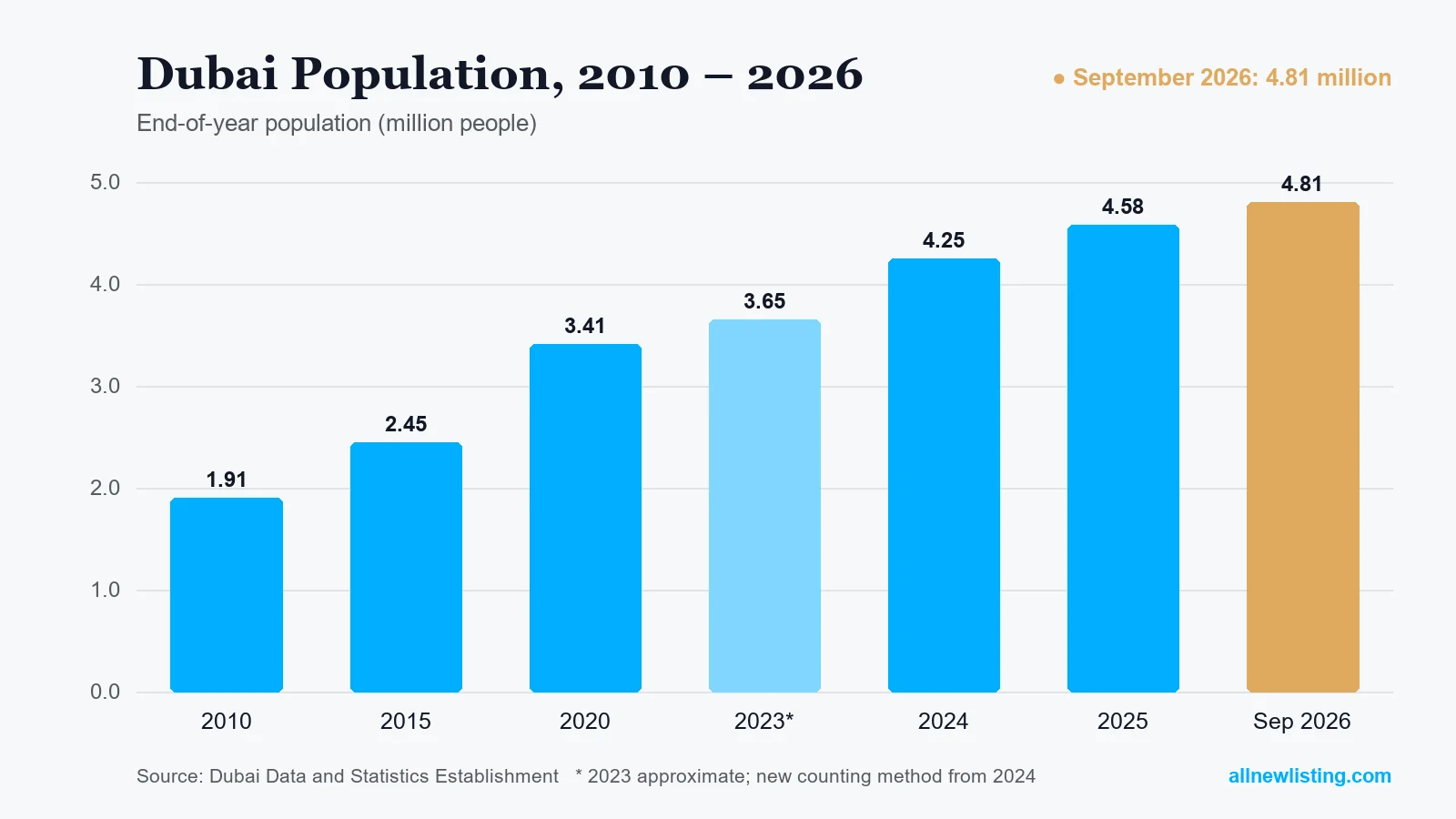
| Year (end of year) | Population |
|---|---|
| 2010 | 1,905,476 |
| 2015 | 2,446,675 |
| 2020 | 3,411,200 |
| 2023* | About 3.65 million |
| 2024 (revised) | 4,248,200 |
| 2025 | 4,580,300 |
| September 2026 | 4,807,185 |
*2023 and earlier years are Dubai Statistics Center estimates made with the old method. The 2022-2024 figures were revised upwards in 2025 using the new register-based method. Under the old method the end-2024 population was around 3.8 million; under the new one it is 4.25 million. Part of the jump between 2023 and 2024 is therefore a change of method, not real growth. Even so, the picture is clear: Dubai's population has grown 2.5 times in 15 years.
Dubai Population by Area
The Dubai Statistics Center's latest community-level estimates are for the end of 2023 and use the old method, but they still show where people are concentrated.
| Community | Population (end-2023 estimate) |
|---|---|
| Jebel Ali Industrial Area 1 | 194,734 |
| Muhaisnah 2 | 144,012 |
| Al Quoz Industrial Area 2 | 131,134 |
| Warsan 1 | 109,468 |
| Hor Al Anz | 86,295 |
| Jebel Ali 1 | 79,425 |
| Al Karama | 78,001 |
| Dubai Investments Park 2 | 77,366 |
| Al Muraqqabat | 74,475 |
| Mirdif | 70,020 |
Most of the top communities are industrial areas with large worker accommodation sites. Hor Al Anz and Al Muraqqabat in Deira and Al Karama in Bur Dubai are older, dense residential districts. Among the newer freehold areas where foreigners can buy, Dubai Marina is the most populated, with about 66,000 residents.
Dubai vs UAE Population
| Area | Population (end of 2024) | Source |
|---|---|---|
| United Arab Emirates | 11,294,243 | Federal Competitiveness and Statistics Centre (FCSC) |
| Dubai | 4,248,200 | Dubai Data and Statistics Establishment (revised) |
| Abu Dhabi | About 4.14 million | Statistics Centre Abu Dhabi (SCAD) |
Dubai is the most populous emirate in the UAE. The capital, Abu Dhabi, is far larger in area but has fewer residents. The UAE's total population grew 5.7% in 2024. Note: the UAE total was calculated before Dubai's revision, so using these two numbers to work out Dubai's share of the UAE would be misleading.
How Population Growth Affects the Property Market
Hundreds of thousands of people move to Dubai every year, and the number of households is growing by close to 8% a year. This creates constant demand for homes to rent and buy. Household growth is the indicator that most directly affects rents. For current rents by area, see our article on average rental prices in Dubai.
Some newcomers also buy property. This demand is moving to newer areas on the edge of the city, such as Dubai South and Jumeirah Village Circle, where prices are lower than in the centre. We have compiled current sale prices area by area on our Dubai house prices page.
Frequently Asked Questions
What is the population of Dubai?
According to the Dubai Data and Statistics Establishment, Dubai's population was 4,807,185 in the last week of September 2026, up from 4,580,300 at the end of 2025.
How many million people live in Dubai?
About 4.8 million. During the day, with commuters from neighbouring emirates and tourists, the number rises to an average of 6.39 million.
What percentage of Dubai's population is foreign?
Dubai does not publish this figure officially. Estimates for the UAE as a whole put expatriates at 88-89% of the population, and the share in Dubai is believed to be higher.
How many Turkish people live in Dubai?
There is no official figure for Turkish residents in Dubai. The number of people moving from Turkey to work, set up businesses and invest has grown in recent years.
Why is Dubai's population growing so fast?
Tax advantages, job opportunities, long-term residency options such as the Golden Visa and a safe environment attract foreigners. The population grew 7.5% in 2025 and about 5% in the first nine months of 2026.
What is the male to female ratio in Dubai?
At the end of 2025, 68.5% of the population was male and 31.5% female. The high share of men is due to foreign workers in construction and services.