
Palm Jumeirah: How Dubai's Palm Island Was Built
28 October 2026
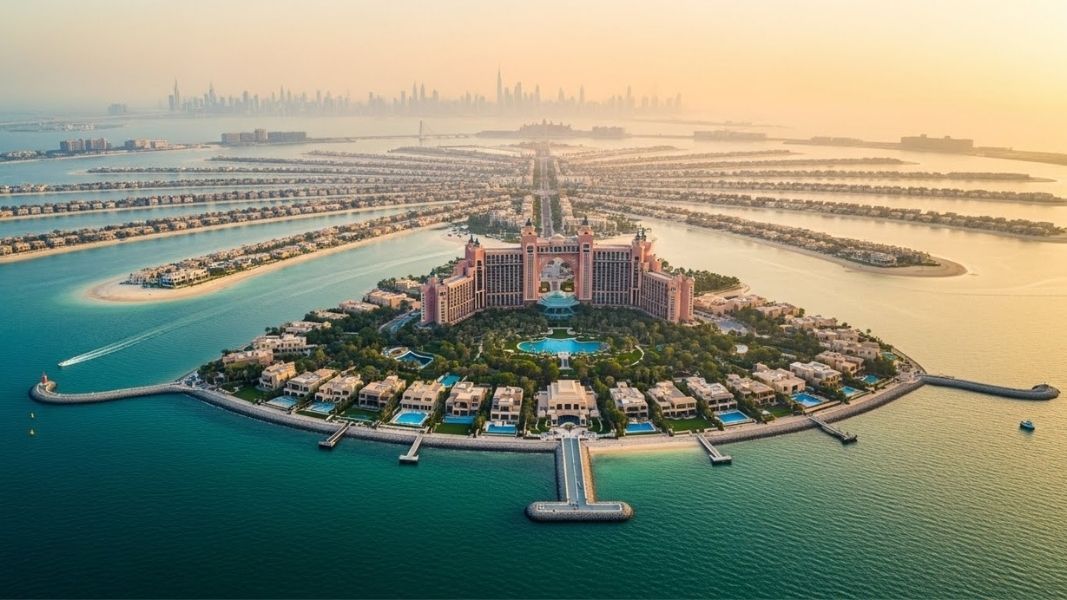
Palm Jumeirah, Dubai's Palm Island, is a palm-shaped artificial island reclaimed from the sea off the Dubai coast. Construction began in 2001 and used 94 million cubic metres of sand and 7 million tonnes of rock. The first residents moved in at the end of 2006. Today more than 26,000 people live on the island, according to Dubai Statistics Center estimates.
This article explains how the island was built, what it cost, its three parts (Trunk, Fronds and Crescent), its population, how to get around, and the latest on its sister project Palm Jebel Ali, using official sources.
Where Is Palm Jumeirah and How Big Is It?
Palm Jumeirah stretches about 5 km from Dubai's Jumeirah coast into the Arabian Gulf. According to developer Nakheel, the island created 560 hectares of new land, roughly the size of 800 football pitches. It has three parts: the Trunk connected to the mainland, 16 Fronds branching off it, and the crescent-shaped breakwater that surrounds them. The fronds are lettered A to P.
How Was Dubai's Palm Island Built?
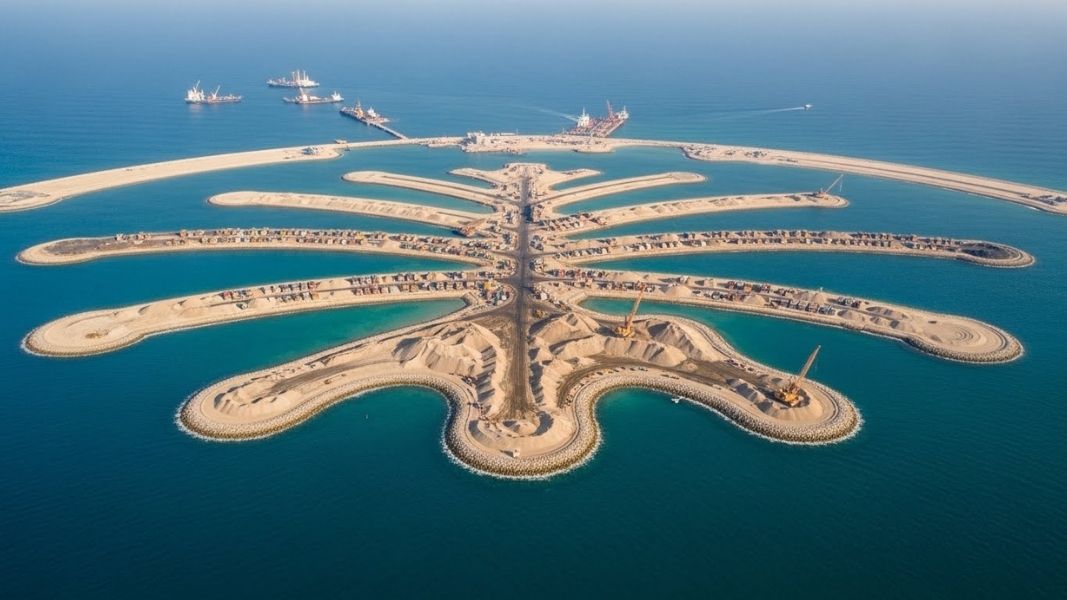
The island is made entirely of sand and rock; no concrete or steel was used to form it. The project was led by government-owned Nakheel, and the reclamation was carried out by Dutch dredging firms such as Van Oord and Boskalis. The work moved in four stages:
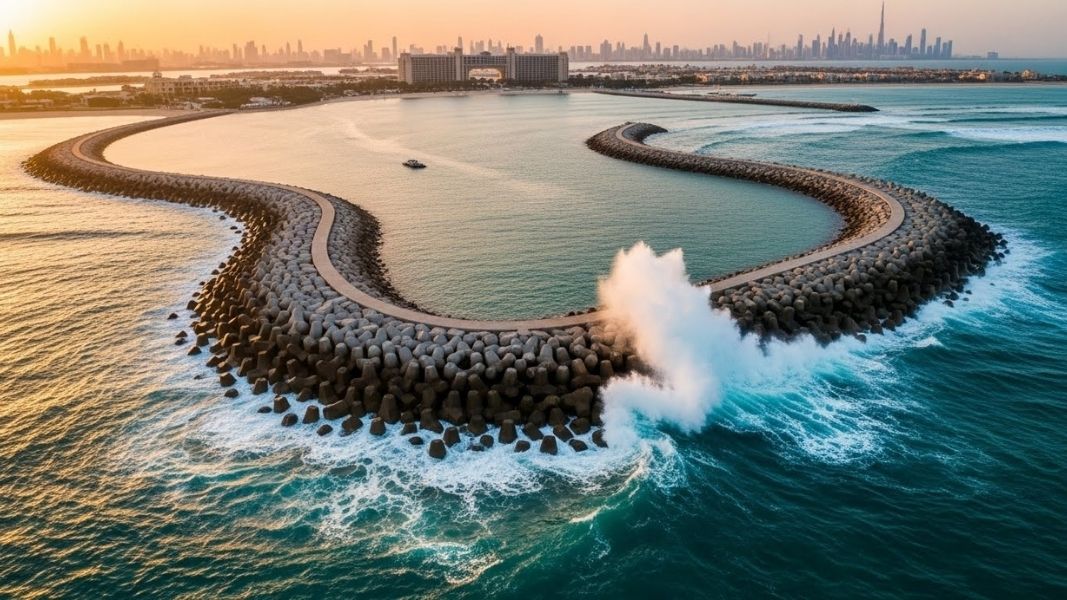
1. Breakwater: First, an 11 km crescent breakwater was built to protect the island from waves. Rock brought from the Hajar Mountains was laid over a geotextile membrane that holds back the sand, with a layer of one-tonne rocks topped by rocks of up to six tonnes. A 100 m opening was left on each side of the crescent to keep the water circulating.
2. Sand spraying: Dredgers pulled sand from the seabed and sprayed it in an arc onto the target area, a technique known as "rainbowing". GPS systems on board the dredgers shaped each frond with great precision.
3. Ground compaction: Loose sand cannot carry buildings, so the ground was strengthened with vibro-compaction. Huge vibrating probes were driven into the sand to pack the grains tightly together.
4. Infrastructure and homes: Reclamation was completed in 2006, the same year the first villas were handed over. A 1.4 km tunnel linking the Trunk to the Crescent runs 25 m below sea level.
How Much Did Palm Jumeirah Cost?
Nakheel has never officially disclosed the island's total cost. The most widely cited estimate is about $12 billion, covering reclamation, infrastructure and the first homes and hotels. For comparison, the Atlantis, The Palm resort at the tip of the island cost $1.5 billion on its own.
Parts of Palm Jumeirah: Trunk, Fronds and Crescent
| Part | What is there? | Highlights |
|---|---|---|
| Trunk | High-rise apartments, a mall, beach clubs | Shoreline Apartments (over 2,600 units), Golden Mile, Nakheel Mall, the 52-storey Palm Tower |
| Fronds (16) | Beachfront detached villas | Garden Homes and Signature Villas, each with a private beach |
| Crescent | Hotels and branded residences | Atlantis, The Palm, Atlantis The Royal, the 11 km breakwater |
The Trunk is the busiest part of the island, with apartments, the mall and the monorail stations. The Fronds offer a quiet, villa-based lifestyle, while the Crescent is almost entirely given over to hotels. The View at The Palm observation deck at the top of The Palm Tower is the easiest way to see the palm shape from above.
How Many People Live on Palm Jumeirah?
Dubai Statistics Center counts the island as a separate community called "Nakhlat Jumeira". Its estimates show the population roughly tripling in a decade:
| Year | Estimated population |
|---|---|
| 2010 | 8,276 |
| 2015 | 10,500 |
| 2020 | 24,741 |
| 2023 | 26,391 |
There is no current official total for the number of homes. According to Nakheel, the first phase of 4,000 villas and apartments sold out within 72 hours. Later projects added many more: Shoreline Apartments alone has over 2,600 apartments and 80 penthouses. We look at population growth across the emirate in our Dubai population article.
Getting to Palm Jumeirah: Monorail, Tunnel and Tram
One of the island's landmarks is the 5.45 km Palm Monorail running along the Trunk. It opened on 30 April 2009 and connects Gateway station on the mainland side with Atlantis Aquaventure station at the tip, with stops such as Al Ittihad Park and Palm Jumeirah Mall in between. The monorail closed for maintenance at the start of 2026 and reopened six months later, in July 2026, with trains every 15 minutes.
Gateway station is within walking distance of the Dubai Tram's Palm Jumeirah stop, and the tram connects to the metro at Dubai Marina. For metro lines and fares, see our Dubai metro guide. Drivers reach the Crescent from the Trunk through the undersea tunnel.
Hotels on Palm Jumeirah
Nakheel's original plan called for more than 30 beachfront hotels along the Crescent and Trunk. The best-known is Atlantis, The Palm, which opened in 2008; Atlantis The Royal followed in 2023. Other luxury hotels on the Crescent include One&Only The Palm, Jumeirah Zabeel Saray and the Waldorf Astoria. Most have a private beach, a water park or a beach club.
Is Palm Jumeirah Sinking?
No. From 2009 onwards, reports claimed the island was sinking by a few millimetres a year. Nakheel firmly denied this and said the island is monitored regularly. The crescent breakwater shields it from open-sea waves. The impact of the reclamation on marine life and coastal sand movement, however, is still debated.
Home Prices on Palm Jumeirah
The island is one of Dubai's most expensive residential areas. Market data based on Dubai Land Department (DLD) records shows that in Q3 2026 villas averaged about AED 85,400 per square metre and apartments about AED 33,200. Villa prices rose about 11% over the year. We cover prices by property type and area and per-square-metre figures on our Palm Jumeirah property prices page.
Palm Jebel Ali: Latest Status
Palm Jebel Ali is the second palm island, about 20 km southwest of Palm Jumeirah. Its reclamation was finished in the 2000s, but the project stalled for years after the 2008 crisis. According to the Dubai Media Office, a new masterplan was approved on 31 May 2023. The island covers 13.4 km², twice the size of Palm Jumeirah. It will add about 110 km of coastline to Dubai, homes for 35,000 families and more than 80 hotels and resorts.
Construction is now moving fast. According to Nakheel's June 2026 statement, 723 villas are under construction on Fronds K to P, with the first handovers starting at the end of 2026. Handovers will come in phases running into 2027 rather than on a single date. In April 2026 Nakheel awarded more than AED 3.5 billion in contracts for 544 villas on Fronds A to F, due for completion in Q4 2028. In August 2026 it released 44 beachfront villas on Frond F.
Frequently Asked Questions
Is Palm Jumeirah artificial?
Yes. Palm Jumeirah is a man-made island built from 94 million cubic metres of sand and 7 million tonnes of rock. No concrete or steel was used to form it.
How long did it take to build Palm Jumeirah?
Reclamation began in 2001 and was completed in 2006, when the first residents moved in. Hotel and residential projects continued in the following years.
How much did Palm Jumeirah cost?
Nakheel has not published an official figure. The most widely cited estimate is about $12 billion.
How many people live on Palm Jumeirah?
According to Dubai Statistics Center estimates, 26,391 people as of 2023, up from 8,276 in 2010.
Is Palm Jumeirah sinking?
No. Developer Nakheel has denied sinking claims. The island is monitored regularly and protected from waves by an 11 km breakwater.
When will Palm Jebel Ali be completed?
According to Nakheel, the first villa handovers start at the end of 2026 and run into 2027. Villas on Fronds A to F are due for completion by the end of 2028.